Visar inlägg med etikett Theory. Visa alla inlägg

fredag 2 september 2016

On poetry and the fatigue of repetition: Jean Nouvel's Louisiana Manifesto

I recently read Jean Nouvel's Louisiana Manifesto and share his thoughts on place, soul and poetry as mentioned in the following extract of his text.
The search for a true architecture in a world of, as he calls them 'princes of repetition' the fatigue of repetition and mediocracy, the importance of getting as far away from preconceived answers as possible and liberating our minds to ask the right questions.
A manifesto so relevant to our time and worth citing:

"Architecture seen as the modification of a physical, atomic, biological continuum.
As the modification of a fragment situated at the heart of our immense universe amidst the dizzying discoveries made by macro- and nano-physics.
Whatever the scale of the transformation, of a site or a place, how are we to communicate the unpredictability of the mutation of a living fragment?
Can we domesticate the visible components - clouds, plant life, living organisms of every size - what signs, reflections, new plantings?
How does one create a vibration that evokes a hidden depth, a soul?
This is surely a task for poetry, since only poetry can produce "the metaphysics of the instant".
To work at the limits of the achievable - with the mysterious, the fragile, the natural.
To anticipate the weathering of time, patina, materials that change, that age with character.
To work with imperfection as a revelation of the limits of the accessible.
These architectures that kill emotion are not Louisianan.
They are that of globe-trotting artist-architects, princes of repetition.
Specialists in the perfect, dry perennial detail, a true confession of emotional impotence!
The repetition of the "controlled" detail as a proof of their insensitivity to the possible nature of an architecture in-the-world."

He goes on to write:

"In the name of the earthly pleasure, we must resist the urbanism of zones, networks, and grids, the automatic rot that is obliterating the identity of the cities of all continents, in all climates, feeding on cloned offices, cloned dwellings, cloned shops, thirsting for the already thought, the already seen in order to avoid thinking and seeing.
We must replace these generic rules, territorial and architectural (yes, architectural! For architecture exists on all scales, and urbanism does not: it is nothing but the mocked-up travesty of a servile architecture on the macro-scale, advancing to prepare the way for the myriad of generic architectures), with other rules based on the structural analysis of the experienced landscape.
We must establish sensitive, poetic rules, approaches that will speak of colours, essences, characters, the anomalies of the act of creation, the specificities of rain, wind, sea, and mountain. Rules that will speak of the temporal and spatial continuum, that will turn the tide towards a mutation, a modification of the inherited chaos, and take account of all the fractal scales of our cities.
These sensitive rules cannot but defy the generic ideology that leads to the proliferation of hegemonic, dominant technologies, creating dependencies, thus tending to hypertrophy all our networks of transport, energy, hygiene, to go for the bottom line.
By contrast, the ideology of the specific aspires to autonomy, to use of the resources of the place and the time, to the privileging of the non-material.
How can we use what is here and nowhere else?
How can we differentiate without caricaturing?
How can we achieve depth?"

Photo by Emelie Nielson 2016, from Assos in Cephalonia, Greece

tisdag 25 november 2014

Nesting

Photo credits Niclas Rosander / http://niclasrosander.se
I was just listening to a seminar by Sou Fujimoto.
He brings up many things that I walk around with on my mind.
His manifesto back to primitive architecture, something called 'Primitive future', is about the relationship between the space and the body. He talks about, how in the beginning when humans lived in caves it was us who adjusted to the spaces we inhabited, found our way to use them and claimed certain spaces for specific functions.
It is this thought of the cave vs. the nest (where the nest has been prepared for human habitation, and a cave is the opposite) the cave requires a creative act on behalf of a human.
The cave alters the behavior of its occupant by offering no indication of how to use the space. Although to some degree this ambiguity is inherent in all spaces, the cave is completely undefined. He calls these creative acts of appropriation the beginning of architecture.

And so by nature humans start to nest - to appropriate and claim space, to give it a smaller - human scale.
It is this human scale, or the variety of scales found in nature (example: trunk/branch/twig/leaf/vein) that makes us somehow feel at ease, in our element.
Fujimoto suggests that is is this duality and coexistence of opposite things that creates the richness and makes us feel safe.
So that in going back to the primitive, and finding its order (or non-exisitng order) and the diversity of scales, accompanied by the duality of openness - closeness (protectetness) is the recipe for the future - primitive future.

Fujimoto is so inspiring and his simple almost childish way of boiling things down to their essence and never ceasing to ask questions about how we use and define space creates something so rich...
It just proves how the process is the most valuable part of a project, how important it is to give thoughts time and room to grow into maturity.
Fujimotos ongoing exploration of this primitive architecture constantly gives birth to new projects and takes him further in his thought process.
It is this process of nourishing an idea, understanding it and being able sort out it's architectural abstraction (which then would have the inherit richness of the original idea) that I am after.


torsdag 1 maj 2014

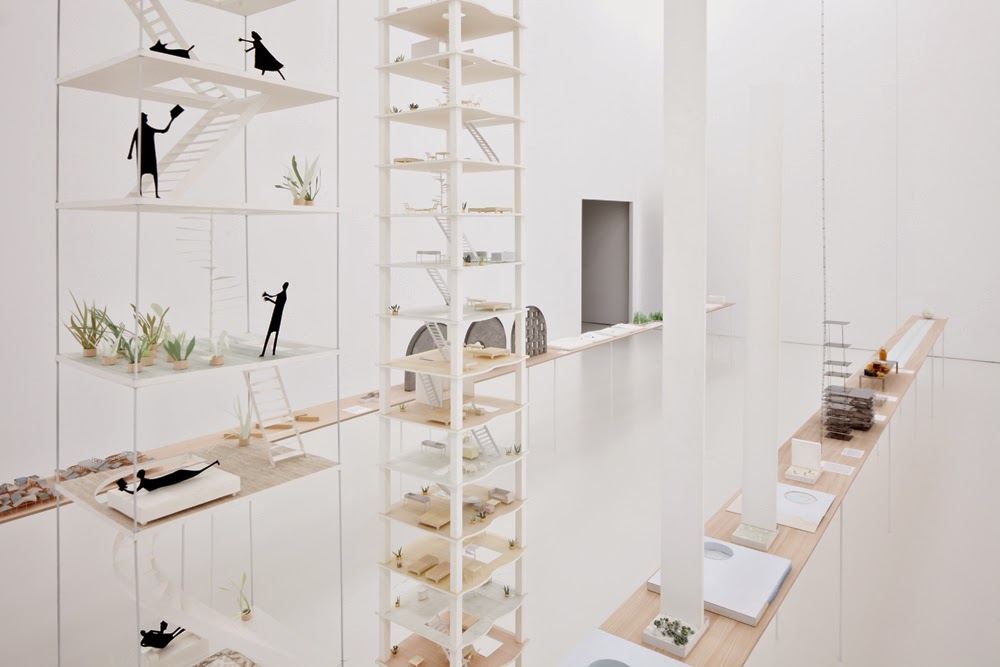
Junya Ishigami, ‘How small? How vast? How architecture grows’

So subtle, all the way from the fine-lined drawing, to the model, to the built.
I could look at the universe of these delicate models all day long.

From the exhibition ‘How small? How vast? How architecture grows’ by Junya Ishigami


Little gardens by Junya Ishigami

Kait Worshop by Junya Ishigami

måndag 7 april 2014

Lightness

Weightless, almost transparent architecture fascinates me. There are a few japanese architects who work with just that, dissolving the limits of the built, that creates an almost dreamlike atmosphere.

The absolute weightless architecture, something that could be identified as lightness or dissolving or transparent, is like this architecture dream, that is realised and keeps the dreaminess and doesn't lose on the way to construction.

Sublime and dreaming go very well together and lightness definitely makes me dream.

Japanese pavilion at the 2008 Venice architecture biennale, by Junya Ishigami

Serpentine pavilion 2009 in Hyde Park, London by SANAA


House NA, also called Transparent House, 2010, by Sou Fujimoto Architects

torsdag 27 februari 2014

Finding the poetry

Architecture that is sublime or architecture that is thriving, to me, manages to find the poetry - /of a space /a context /an environment and becomes the most it can be. Capturing the specific characteristics of a site, reinventing and playing with the landscape, how a project is a part of or forms something externally and internaly. Finding the poetry is always a common mentioner.

Alvaro Siza is extremely good at finding the poetry. It seems like a sharp eye (pure talent also of corse) and travels can do that to a person.
Like with his Portuguese World expo pavilion from 98, the horizontal thin sheet that is held up on each side by rhythmic columns that forms spaces between them. The sheet is so thin, almost like a boat sail or a paper sheet laying across, that it is hard to grasp how the construction is even made up. The entity forms a frame through which one can see the blue horizon of the ocean.

Sketch by my friend Camilla Levin during our trip to Portugal in 2012
(Portuguese World expo pavilion '98 by Alvaro Siza)


lördag 27 april 2013

'Sublime et architecture' by Didier Laroque


I have found this book 'Sublime et architecture recherche pour une esthétique' by Didier Laroque that interests me very much. I will read it as soon as I get my hands on a copy.

Didier Laroque is an architect, writer and is a Doctor of philosophy in urban studies.
The book was published in 2010 and has received a lot of criticism as well as praise, I am eager to find it out for my self.

I would love to go back to studying for the sake of philosophy. Would I ever decide to get a Ph.D.
Hooray that know french.

måndag 1 april 2013

mys·ter·y

I have been thinking for a while of what to write about next.
That maybe I should try not to go into too existential subjects, to keep it more logical.

It is not easy, because it gets personal and that is often the way I think about things and the subject is connected to feelings and experience.

However, what I have been thinking about is that the sublime in buildings that amaze me has to include some kind of mystery.

I found this definition of mystery at thefreedictionary.com

1. One that is not fully understood or that baffles or eludes the understanding; an enigma: How he got in is a mystery.

2. One whose identity is unknown and who arouses curiosity: The woman in the photograph is a mystery.

3. A mysterious character or quality: a landscape with mystery and charm.

4. A work of fiction, a drama, or a film dealing with a puzzling crime.

5. The skills, lore, or practices that are peculiar to a particular activity or group and are regarded as the special province of initiates. Often used in the plural: the mysteries of Freemasonry; the mysteries of cooking game.

6. A religious truth that is incomprehensible to reason and knowable only through divine revelation.

torsdag 13 december 2012

Traveling through stations

This past week I have come across some photos of old stations. I guess there is often something very magic with old photos. They have captured something that you could never, as much as you would want to, be a part of. A moment that can never be relived but is forever captured so that we can get a glimpse of it.
Stations Especially fascinates me. There are so many people passing every day, all the emotional or still rendrez-vous, both joyful and sad.

I really like the time during traveling, you find yourself in a non-place, a vacuum in time, to just be. Maybe there is something sublime in that feeling in itself for me, although that feeling is also associated to the grand spaces that often house our traveling situations.
The sounds, the atmosphere of excitement, the fluidity.
Big stations provides us with the safety of direction, it herds us in the way to go.
You are surrounded by many people, more than you are probably used to. Stations have directions and destinations, with your eyes you can follow the (track / train / boat / airplane) until they disappear out of your sight.
Of corse there are awful stations, but then there are some amazing ones that have the ability to stun.

I think these photos of The old Grand central station in New York are stunning. Not only because the exposure makes the light almost surreal, as if it is coming down in cascades from the walls, but they tell me something about the richness of being there. The atmosphere, once again, the grandeur.
The continuity of the space, the little island in the middle, the feeling of almost being in a big bunker, people moving around you.
Is there something that we do there, that we don't do anywhere else (besides traveling)? Reading a newspaper to pass the time, trying to remember just how a person looks in that moment, looking at strangers, getting lost in thoughts. The transit is a very exciting instance and so a station is what takes you there an leads the first little part-, or last.
I am not going to define what I think makes a good station, what I am thinking is, that the sublime is probably there if the station just is and with all diligence lifts all of these things.
People are on their way on these photos, but the Grand central is place very hard to forget. It gets to be the beginning and the end.


The Grand Central station, c.1930 photographed by Hal Morey

People on the move


The rail yard

torsdag 8 november 2012

Sublime in architecture and function

I got an email from my friend last week who works in the art world. The reflections we shared had to do with the way art and design are separated by use. Essentially that architecture has a use or function, which renders it hard to classify as sublime.

I think that the sublime is outside of our made up parameters and it is not hindered by definitions.
If the sublime can appear in things created (such as art and literature) what would prevent it from existing in architecture?

A teacup does not know that it is a teacup. I could argue that there is such a thing as 'useless' architecture. It is architecture just for architecture's sake (a sort of fetish where the purpose is the experience) or architecture that holds great architectonic quality but is not user-friendly or fulfilling it's original purpose in a logical way, let's say it is not functional.
Although, it was traditionally agreed for a very long time that good architecture should be able to accomplish 'the three attributes' firmitas, utilitas, venustas (stability, utility, beauty).


Axel Schultes and Charlotte Frank’s Crematory in Berlin

torsdag 1 november 2012

Purpose


I am an architect who in the quest of exploring what drives me created this blog for purely selfish reasons. I am fascinated by atmospheres, by sacral architecture; or rather 'the spirited'. Architecture that does not have to have been built with those values in mind, but inherent these (to me) qualities, that often takes one by surprise. 

As in Ashley-Cooper, third earl of Shaftesbury, Dennis and Addison's journey to the alps in the 18th century I intend to, with this blog as my notebook, explore the (purely subjective) sublime in architecture and beyond.

Sublime, to me is the awe of the great, it can bring both pleasure/delight and fear/horror at the same time. 
It often comes with a melancholia for me for what does not last or has a beauty hard to grasp. The sublime I recognise as lofty and poetic, it creates emotions and speak to me. It is the magic of the real and the beauty it can possess.
Because, to me the sublime is not beauty, it is something else although the sublime can possess beauty beyond the bounds of beauty as a concept.

Maybe I will be able to put my finger on the great fascination that I have when I find the sublime in architecture, what is it that creates it and what it is to me. Maybe I will never be able to put my finger on anything other than the outcome it brings. Nevertheless, it is the journey of exploring I am after and what it can bring outside of this blog.