Visar inlägg med etikett Nature. Visa alla inlägg

söndag 15 maj 2016

In praise of shadows

Mouthon Charles-Francois - Academie Beaux arts 1892
I recently read In praise of shadows by Jun'ichirō Tanizaki, I remember reading it a long time ago when I started architecture school and Tanizaki's way of suddenly changing one subject to another,
in praise of old Japanese culture, architecture and practice.
The beauty of this little novel really is food for the soul,
He moves from moonlit toilets at the Kyoto temple to dark lacquerware glimmering like jewels in the dark to women with blackened teeth in the pleasure houses, where only their very white skin, sheer as a ghost's transcends out of the darkness.
The Japanese really understand the beauty of time, of ageing and of the sublime in the shadows.

This is Tanizaki's thoughts on toilets:

"Every time I am shown to an old, dimly lit, and, I would add, impeccably clean toilet in a Nara or Kyoto temple, I am impressed with the singular virtues of Japanese architecture. The parlor may have its carms, but the Japanese toilet truly is a place of spiritual repose. It always stands apart from the main building, at the end of a corridor, in a grove fragrant with leaves and moss. No words can describe that sensation as one sits in the dim light, basking in the faint glow reflected from the shoji, lost in meditation or gazing out at the garden. The novelist Natsume Sōseki counted his morning trips to the toilet a great pleasure, 'a physiological delight' he called it. And surely there could be no better place to savor this pleasure than a Japanese toilet where, surrounded by tranquil walls and finely grained wood, one looks out upon blue skies and green leaves.
As I have said there are certain prerequisites: a degree of dimness, absolute cleanliness, and quiet so complete one can hear the hum of a mosquito. I love to listen from such a toilet to the sound of softly falling rain, especially if it is a toilet of the Kantō region, with its long, narrow windows at floor level; there one can listen with such a sense of intimacy to the raindrops falling from the eaves and the trees, seeping into the earth as they wash over the base of a stone lantern and freshen the moss about the stepping stones. And the toilet is the perfect place to listen to the chirping of insects or the song of the birds, to view the moon, or to enjoy one of those pognant moments that mark the change of the seasons. Here, I suspect, is where haiku poets over the ages have come by a great many of their ideas. Indeed one could with some justice claim that of all the elements of Japanese architecture, the toilet is the most aestetic. Our forbears, making poetry of everything in their lives, transformed what by rights should be the most unsanitary room in the house into a place of unsurpassed elegance, replete with fond associations with the beauty of nature..."

söndag 29 november 2015

Noémie Goudal 'Observatoires' 2015

I can't get these mesmerizing images by french artist Noémie Goudal out of my head.
Surreal, barren landscapes where abandoned architecture meets nature in a dreamy, theatrical setting...
(Inspired by Jantar Mantar, built in Jaipur, India, in the 18th Century)


fredag 4 september 2015

Esparon, the house on a mountain

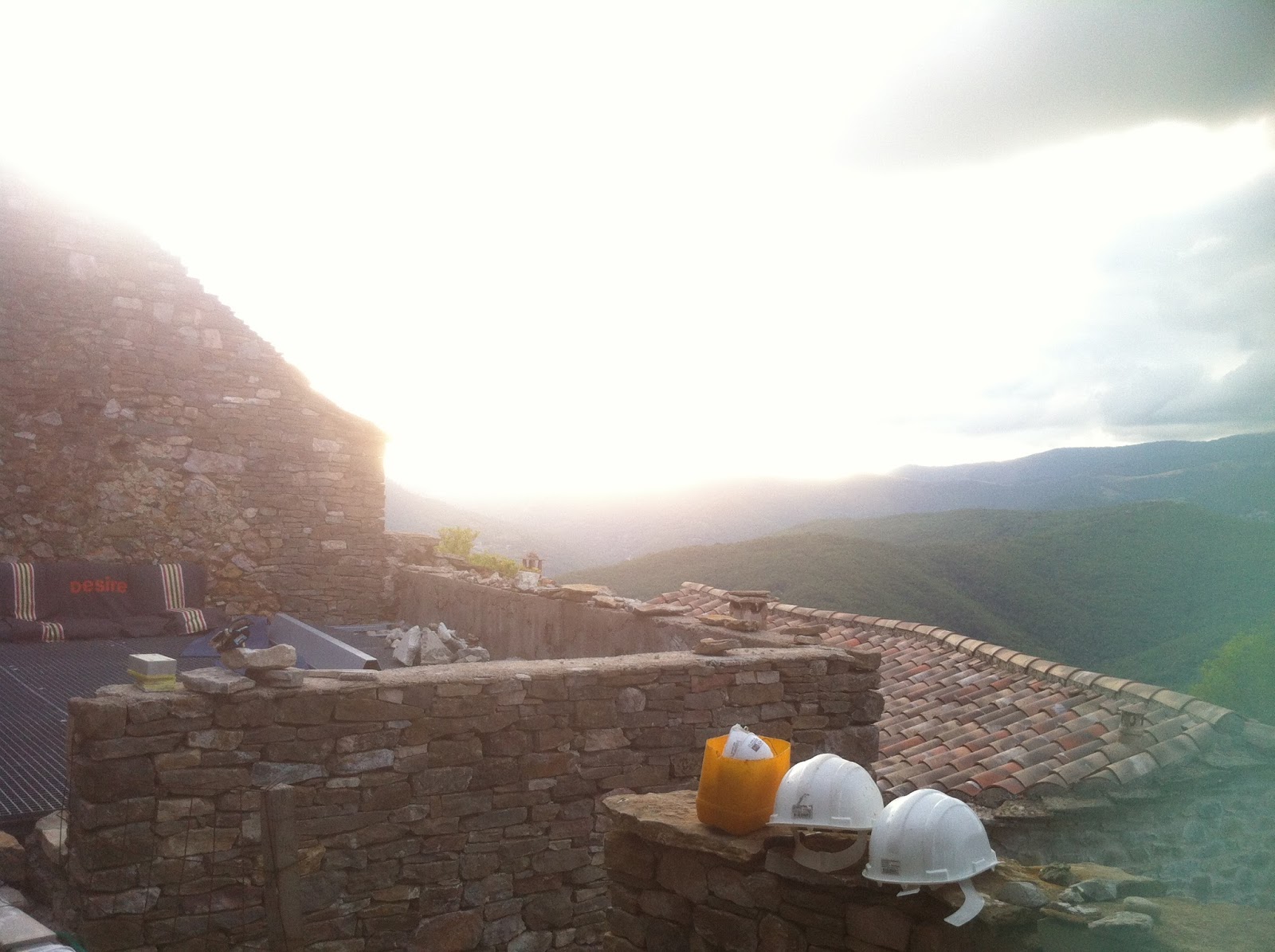
I just got back from helping architect friends to build their house in South of France. One hour from Nîmes, the town with the beautiful light there is a small village on top of a mountain. They bought an old ruin, and preserving the old walls and the layout, they are now building on to it.

There was a full moon, and you could see the moonlit valley and the unfinished roof.
So quiet, you could hear the owl sounds and see the mountains 280 degrees around you.
Everything about this place is just magical.

lördag 30 maj 2015

tisdag 14 april 2015

We were there - Porto

Three years ago we visited Leça Swimming Pools by Alvaro Siza, north of Porto, Portugal.
Porto is a fantastic place to go for architectural visits (go if you haven't been!)
The pools were finished in 1966, but they have aged gracefully and do not feel decayed, despite the Atlantic oceans tough treatment.
The area is completely sunken down, out of view of the cityscape on the side and disconnected from the city, melting into the ocean as apart of it.
You are lead as in procession through the changing rooms, via a ramp down towards the ocean.
The pools are molded into the the cliffs with concrete of the same color as the stone, mixed with the natural water gatherings of the ocean side, it is sensational place.
I would love to revisit in the summer, it was early spring when we were there.


Photo credits: Camilla Levin


Photo credits: Camilla Levin


Photo credits: Camilla Levin

onsdag 18 mars 2015

You framed it so now I can see it

Krijn de Koning is exhibiting in Paris right now at Centquatre until the beginning of april.
When I woke up this morning I was looking at images of his Het groene huis from 2014 and it completely captivated me.
The effect that colors has on me (you as well?) is amazing and the way that he works with the environment around, the light and the perspectives framing it altogether is dreamlike to me.

He often works with rich environments like nature and ruins and in these photos,
it's just like scenography or footage.

Photo credit: http://www.krijndekoning.nl/

Photo credit: http://www.krijndekoning.nl/


Photo credit: http://www.krijndekoning.nl/

Photo credit: http://www.krijndekoning.nl/

Photo credit: http://www.krijndekoning.nl/

Photo credit: http://www.krijndekoning.nl/

Photo credit: http://www.krijndekoning.nl/


söndag 8 februari 2015

Petra, Jordan / a rose-red city half as old as time

It seems no work of man’s creative hand,
by labour wrought as wavering fancy planned;
But from the rock as if by magic grown,
eternal, silent, beautiful, alone!


Not virgin-white like that old Doric shrine,
where erst Athena held her rites divine;
Not saintly-grey, like many a minster fane,
that crowns the hill and consecrates the plain;


But rose-red as if the blush of dawn,
that first beheld them were not yet withdrawn;
The hues of youth upon a brow of woe,
which man deemed old two thousand years ago,
match me such marvel save in Eastern clime,
a rose-red city half as old as time.

—John Burgon, 1845


Al Khazneh or The treasury at Petra, 1st century AD
Photo credits: http://www.ereduvoyage.ch
Photo credits: http://www.unp.me

Photo credits: http://www.unp.me

Photo credits: http://www.unp.me

onsdag 28 januari 2015

The eucalypt forest


This winter we went to Australia for a month. It was hot, but up in the Blue mountains the air was cool.

The Blue mountains north-west of Sydney is a national park (of 267,954-hectare) with mountains, rivers, waterfalls, an abundance of magical scenery and natural beauty.

The Blue mountains name derives from the sheer blue haze over the mountains, said to be produced by the dense forest of oil bearing eucalyptus trees.

This summer after a walk, the rain came down heavy and as I walked by the eucalyptus trees I could breathe in the fresh eucalyptus fragrance that the big eucalypt forest was giving away. Like a big, blue healing lung. That's sublime.

Photo by Emelie Nielson 2014


torsdag 30 oktober 2014

Short film by Mark Tipple

When photographer Mark Tipple filmed the ocean and the ocean wasn't so nice anymore...

lördag 20 september 2014

The ocean by Mark Tipple

I have an obsession with the ocean, it draws me and scares me. It puts me in awe and invites.
So amazing and sometimes not at all inviting.
Powerful and forceful, pure energy of mass moving...
All of these photos are taken under water by Mark Tipple. Wow.


torsdag 11 september 2014

Landscapes

What inspires me the most of all to create is landscapes.
It can at occasions be cityscapes or urbanized areas but most of all it is natural landscapes.
My dream is to travel the world and just go from place to place to experience them.
Like Bryce canyon, I would like to go there.

Bryce canyon in Utah, photo credits to http://nirvanaexcursions.com/

lördag 19 oktober 2013

fredag 21 juni 2013

The crevice

When I was about 16 years old we went on a long walk in the forest 'Skulesogen' in north of Sweden.
It is one of the strongest spatial memories I have, especially the crevice in the mountain where we walked.
See, I grew up with these amazing tales by Swedish author Astrid Lindgren, and one of her characters, Ronja (who was the daughter of the master thief of the woods) lived in a mystic primeval forest.
'Ronia, the robber's daughter' was made into a movie, and the split in the mountain that separated the thief families was filmed in this very place. The actual physical place is called 'Slåttdalsskrevan'.

The crevice is a 200 meters long split in the mountain, with 10-storey high cliffs on either side. The narrow passage is humid and often misty. You are walking deep into the mountain, coming out on the other side, once again in a deep forest that encloses you.
After the walk through the crevice, you eventually reach a high place up on the cliffs.
A grand view over the waters, cliffs and forests spreads out for miles. My stepmother had to sit down because the mere presence of the view made her knees weak and she got a bit lightheaded by the hight. Wow, this is truly a beautiful place.
Nature does it best, and then architecture does it. The sublime in the narrow passage, almost like an underwater experience where you see the light surface far away on top of you, a streak of light. The physical presence of the cliffs making you feel like a tiny insect seeking their way in a difficult landscape and then the grandiose opening of the landscape, far beyond what you can comprehend.
Tours like these stay in my memory and inspire me in architecture, far more than any architecture blogg or built reality ever could. Because nature does it best and it is raw in it's approach.


The influence that Astrid Lindgren's tales have had, the film adaptations with dreamlike landscapes like 'The brothers lionheart' and 'Ronia, the robber's daughter' has made a lifelong impression on me.
If you get the opportunity to see them or show them to your kids, I think you should.

Photo: cyberphoto.se / Thomas Lövgren

Photo: Naturvardsverket.se / Michael Engman / Engmanbild

Photo: Skuleskogen.se / Carolina Hillerdal


onsdag 22 maj 2013

National Assembly Building of Bangladesh by Louis Kahn

This is a building I would love to visit.
Louis Kahn has interested me ever since I started doing architecture.
Khan was considered to be a modernist but his work is distinguished from other contemporary architects of that time and in my opinion this building is special.

The National Assembly Building of Bangladesh could not (with favor) be moved anywhere else.
It has context, and it uses it beautifully. The monolithic is there throughout Khans oeuvres, here it melds together with pakistani/bengali tradition and takes on a new identity. It has strong identity and place.
The surrounding water and the light creates the conditions and the richness that the space plays with.
The concrete gets to play a well-favored role as it meets with the water and is mass but at the same time merges geometric openings that flood in light.
The halls are aligned around a central parliamentary grand chamber at the heart of the building,
which does not only fit the program as a core but also conceptualizes the light as space that Khan had in mind.
To me, this building has a certain inherit prime of sci-fi film mystery.

Still-image from the documentary 'My architect'

Courtesy of Wikimedia Commons

'Brutal/beautiful?' from http://ilbonito.wordpress.com

Via Archidaily by Naquib Hossain

Geometry

onsdag 8 maj 2013

Architecture as meteorology

Philippe Rahm Architectes is a Paris-based architecture practice led by swiss architect Philippe Rahm.
Their philosophy is towards a meteorological architecture. This is how their approach is explained on their website:  
'Climate change is forcing us to rethink architecture radically, to shift our focus away from a purely visual and functional approach towards one that is more sensitive, more attentive to the invisible, climate-related aspects of space. Slipping from the solid to the void, from the visible to the invisible, from metric composition to thermal composition, architecture as meteorology opens up additional, more sensual, more variable dimensions in which limits fade away and solids evaporate. 
The task is no longer to build images and functions but to open up climates and interpretations. 
At the large scale, meteorological architecture explores the atmospheric and poetic potential of new construction techniques for ventilation, heating, dual-flow air renewal and insulation.'

Make architecture an actual cloud. If the sublime is experienced with all senses and architecture in space has the power to bestow these, architecture as meteorology makes perfect sense if it is effective.

At zona Tortona, Milan 2009 Philippe Rahm created “De-Territorialized Mileus, a “climate-related performance installation” that considers the relationships between indoor and outdoor and artificial and natural surroundings. His working hypothesis was on display as futuristic forms of air purification, heating and lighting, all which have the end goal of “naturalizing” an indoor living space in phase with the external environment, but without the negative effects of atmospheric pollution and global warming. (http://inhabitat.com/the-best-of-zona-tortona/)

måndag 22 april 2013

Bruder Klaus chapel by Peter Zumthor


The local farmers helped with the construction of this very silent place of worship, built for the saint Bruder Klaus on a wide field in Mechernich in Germany. 
The shape of a tower derives from the story of Bruder Klaus first vision as a teenager, worshiping in a tower.
The farmers made the outer walls by pouring 50 cm of concrete around 112 tree trunks every day for 24 days to create different layers, varying in and color and texture. Afterwards, the structure was slowly burnt out, leaving a charcoal black surface impressed with the markings of trees.

They simple calm and the poetic position of this concrete tower on the field as well as the humble approach speaks to me. It is a intriguing example of how a construction method can enrich and be a part of the built. It is something about the processus of the built and the contrast between the sleek yet textured outside to the dark core with an opening to the sky.
I would love to experience snowflakes slowly falling from above in this place.