Visar inlägg med etikett Landscape. Visa alla inlägg

fredag 2 september 2016

On poetry and the fatigue of repetition: Jean Nouvel's Louisiana Manifesto

I recently read Jean Nouvel's Louisiana Manifesto and share his thoughts on place, soul and poetry as mentioned in the following extract of his text.
The search for a true architecture in a world of, as he calls them 'princes of repetition' the fatigue of repetition and mediocracy, the importance of getting as far away from preconceived answers as possible and liberating our minds to ask the right questions.
A manifesto so relevant to our time and worth citing:

"Architecture seen as the modification of a physical, atomic, biological continuum.
As the modification of a fragment situated at the heart of our immense universe amidst the dizzying discoveries made by macro- and nano-physics.
Whatever the scale of the transformation, of a site or a place, how are we to communicate the unpredictability of the mutation of a living fragment?
Can we domesticate the visible components - clouds, plant life, living organisms of every size - what signs, reflections, new plantings?
How does one create a vibration that evokes a hidden depth, a soul?
This is surely a task for poetry, since only poetry can produce "the metaphysics of the instant".
To work at the limits of the achievable - with the mysterious, the fragile, the natural.
To anticipate the weathering of time, patina, materials that change, that age with character.
To work with imperfection as a revelation of the limits of the accessible.
These architectures that kill emotion are not Louisianan.
They are that of globe-trotting artist-architects, princes of repetition.
Specialists in the perfect, dry perennial detail, a true confession of emotional impotence!
The repetition of the "controlled" detail as a proof of their insensitivity to the possible nature of an architecture in-the-world."

He goes on to write:

"In the name of the earthly pleasure, we must resist the urbanism of zones, networks, and grids, the automatic rot that is obliterating the identity of the cities of all continents, in all climates, feeding on cloned offices, cloned dwellings, cloned shops, thirsting for the already thought, the already seen in order to avoid thinking and seeing.
We must replace these generic rules, territorial and architectural (yes, architectural! For architecture exists on all scales, and urbanism does not: it is nothing but the mocked-up travesty of a servile architecture on the macro-scale, advancing to prepare the way for the myriad of generic architectures), with other rules based on the structural analysis of the experienced landscape.
We must establish sensitive, poetic rules, approaches that will speak of colours, essences, characters, the anomalies of the act of creation, the specificities of rain, wind, sea, and mountain. Rules that will speak of the temporal and spatial continuum, that will turn the tide towards a mutation, a modification of the inherited chaos, and take account of all the fractal scales of our cities.
These sensitive rules cannot but defy the generic ideology that leads to the proliferation of hegemonic, dominant technologies, creating dependencies, thus tending to hypertrophy all our networks of transport, energy, hygiene, to go for the bottom line.
By contrast, the ideology of the specific aspires to autonomy, to use of the resources of the place and the time, to the privileging of the non-material.
How can we use what is here and nowhere else?
How can we differentiate without caricaturing?
How can we achieve depth?"

Photo by Emelie Nielson 2016, from Assos in Cephalonia, Greece

söndag 28 februari 2016

There is not enough fantastical architecture out there


Claude Parent passed away yesterday at the age of 93, the world lost a great architect.

We just went to see an exhibition at Galerie Azzedine Alaïa in Paris with three museum projects of his presented the other week.
I am so impressed by the world of Claude Parent, he worked right up until his death, only the the hand-drawn lines were shakier.

There is not enough fantastical architecture out there, I wish that many more of his project were built!

His work is really one of a kind, between utopia and reality, the French pavillon for the Venice Biennale in 1970 for example reminds me, in some ways of one of my favorites, 'Lustiga huset' at the amusement park Gröna Lund in Stockholm. A house which proportions and features takes you through a mind-game where the stairs move, you walk on something that you don't know if it is a wall or a floor. This house will always stay in my memory since childhood in the same way Claude Parent's work always makes you want to explore the world of his oblique architecture.

Vive l'architecture oblique! His work will live on forever.


Project presented by Claude Parent at the 1970 architecture biennale


Project presented by Claude Parent at the 1970 architecture biennale


Project by Claude Parent at the 1970 architecture biennale


Drawing by Claude Parent

tisdag 26 januari 2016

Continuous space

One of the things that make me dream the most...is continuous spaces, linear continuous spaces. 
Here are three uninterrupted spaces: two by the SANAA ensemble and one by Ryue Nishizawa on his own.
They are quite similar, responding to the different programs with the same elaboration, the new generation of Japanese continuity.

Teshima art museum by Ryue Nishizawa and artist Rei Naito, photo credits: © iwan baan

Teshima art museum by Ryue Nishizawa and artist Rei Naito, photo credits: Illabo


Rolex learning center by SANAA, photo credits:
© SANAA by Cyrille Thomas
Serpentine pavilion 2009 by SANAA, photo credits:
Archinect

söndag 29 november 2015

Noémie Goudal 'Observatoires' 2015

I can't get these mesmerizing images by french artist Noémie Goudal out of my head.
Surreal, barren landscapes where abandoned architecture meets nature in a dreamy, theatrical setting...
(Inspired by Jantar Mantar, built in Jaipur, India, in the 18th Century)


fredag 4 september 2015

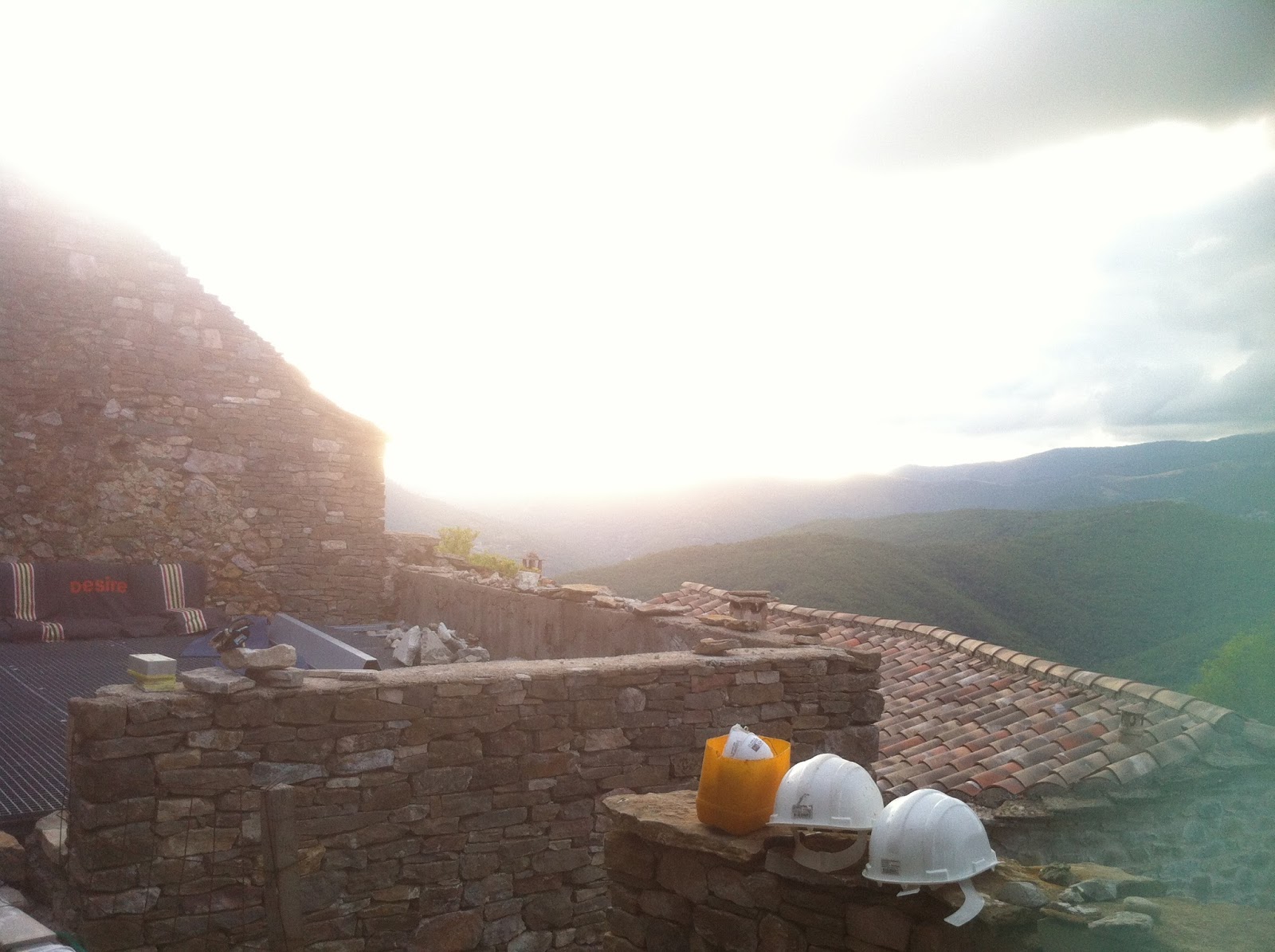
Esparon, the house on a mountain

I just got back from helping architect friends to build their house in South of France. One hour from Nîmes, the town with the beautiful light there is a small village on top of a mountain. They bought an old ruin, and preserving the old walls and the layout, they are now building on to it.

There was a full moon, and you could see the moonlit valley and the unfinished roof.
So quiet, you could hear the owl sounds and see the mountains 280 degrees around you.
Everything about this place is just magical.

lördag 30 maj 2015

tisdag 14 april 2015

We were there - Porto

Three years ago we visited Leça Swimming Pools by Alvaro Siza, north of Porto, Portugal.
Porto is a fantastic place to go for architectural visits (go if you haven't been!)
The pools were finished in 1966, but they have aged gracefully and do not feel decayed, despite the Atlantic oceans tough treatment.
The area is completely sunken down, out of view of the cityscape on the side and disconnected from the city, melting into the ocean as apart of it.
You are lead as in procession through the changing rooms, via a ramp down towards the ocean.
The pools are molded into the the cliffs with concrete of the same color as the stone, mixed with the natural water gatherings of the ocean side, it is sensational place.
I would love to revisit in the summer, it was early spring when we were there.


Photo credits: Camilla Levin


Photo credits: Camilla Levin


Photo credits: Camilla Levin

söndag 8 februari 2015

Petra, Jordan / a rose-red city half as old as time

It seems no work of man’s creative hand,
by labour wrought as wavering fancy planned;
But from the rock as if by magic grown,
eternal, silent, beautiful, alone!


Not virgin-white like that old Doric shrine,
where erst Athena held her rites divine;
Not saintly-grey, like many a minster fane,
that crowns the hill and consecrates the plain;


But rose-red as if the blush of dawn,
that first beheld them were not yet withdrawn;
The hues of youth upon a brow of woe,
which man deemed old two thousand years ago,
match me such marvel save in Eastern clime,
a rose-red city half as old as time.

—John Burgon, 1845


Al Khazneh or The treasury at Petra, 1st century AD
Photo credits: http://www.ereduvoyage.ch
Photo credits: http://www.unp.me

Photo credits: http://www.unp.me

Photo credits: http://www.unp.me

onsdag 28 januari 2015

The eucalypt forest


This winter we went to Australia for a month. It was hot, but up in the Blue mountains the air was cool.

The Blue mountains north-west of Sydney is a national park (of 267,954-hectare) with mountains, rivers, waterfalls, an abundance of magical scenery and natural beauty.

The Blue mountains name derives from the sheer blue haze over the mountains, said to be produced by the dense forest of oil bearing eucalyptus trees.

This summer after a walk, the rain came down heavy and as I walked by the eucalyptus trees I could breathe in the fresh eucalyptus fragrance that the big eucalypt forest was giving away. Like a big, blue healing lung. That's sublime.

Photo by Emelie Nielson 2014


torsdag 11 september 2014

Landscapes

What inspires me the most of all to create is landscapes.
It can at occasions be cityscapes or urbanized areas but most of all it is natural landscapes.
My dream is to travel the world and just go from place to place to experience them.
Like Bryce canyon, I would like to go there.

Bryce canyon in Utah, photo credits to http://nirvanaexcursions.com/

torsdag 21 augusti 2014

Sanfångaren / The sand catcher by Eva Johansson

I have since a long time thought about changing landscapes and how architecture could change with the landscape. I have specifically thought about tides and water, how architecture could be integrated into that and life cycles.
Dreaming about such a project, I came to think about a very poetic project, diploma thesis at KTH Architecture school in Stockholm by Eva Johansson in 2013.

The project investigates how a structure and spaces can change with the ever-moving sand dunes of north Jylland in Denmark.

This is how she explains her project:

"I am fascinated by landscape that rapidly changes and is shaped by 
wind and water. The wandering sand dune 'Rabjerg Mile' in northern Denmark 
moves across the North Jylland peninsula 15 feet per year. By introducing a 
built structure, a permanent element on site asserts the sand dune's 
rampage and thus man's view of time and place. It is a lookout tower, 
a landmark, a measuring stick, and a visitor centre. The building's main task will be to 
accentuate Rabjerg Miles movement. The sand is active and continuously generates 
new spaces and spatial experiences. 

Rabjerg Mile is one of the largest migratory dunes in Europe. The sand cushion measures 
1 km wide and is moving over the cape in a north-easterly direction. Rabjerg Mile consists of 
about 4 million cubic meters of sand. On average Rabjerg Mile moves about 10-20 
meters per year, depending on the wind strength. 

During the 1500s and 1600s large areas of Denmark  had trouble with
shifting sand. The sand destroyed crops, graveled back roads and forced 
residents to move from their homes. Year 1905 the state bought the land around Rabjerg 
Mile and created a conservation area to preserve the phenomenon moving sand. 
Since then, the sand dune has moved 1.5 km. In about a 100 years the road  
and the railway up to Skagen will be completely sanded over.'


måndag 31 mars 2014

SALT

The dead sea, Israel, photographer unknown

The dead sea, Israel, photographer unknown

Salinas grandes, Jujuy, Argentina, photographer unknown

Salinas grandes, Jujuy, Argentina, photographer unknown


Salinas grandes, Jujuy, Argentina, photographer unknown

Saltworks in Bilma, Niger, photographer unknown

Saltworks in Bilma, Niger, photographer unknown

Saltworks in Bilma, Niger, photographer unknown