Visar inlägg med etikett Poetry. Visa alla inlägg

fredag 2 september 2016

On poetry and the fatigue of repetition: Jean Nouvel's Louisiana Manifesto

I recently read Jean Nouvel's Louisiana Manifesto and share his thoughts on place, soul and poetry as mentioned in the following extract of his text.
The search for a true architecture in a world of, as he calls them 'princes of repetition' the fatigue of repetition and mediocracy, the importance of getting as far away from preconceived answers as possible and liberating our minds to ask the right questions.
A manifesto so relevant to our time and worth citing:

"Architecture seen as the modification of a physical, atomic, biological continuum.
As the modification of a fragment situated at the heart of our immense universe amidst the dizzying discoveries made by macro- and nano-physics.
Whatever the scale of the transformation, of a site or a place, how are we to communicate the unpredictability of the mutation of a living fragment?
Can we domesticate the visible components - clouds, plant life, living organisms of every size - what signs, reflections, new plantings?
How does one create a vibration that evokes a hidden depth, a soul?
This is surely a task for poetry, since only poetry can produce "the metaphysics of the instant".
To work at the limits of the achievable - with the mysterious, the fragile, the natural.
To anticipate the weathering of time, patina, materials that change, that age with character.
To work with imperfection as a revelation of the limits of the accessible.
These architectures that kill emotion are not Louisianan.
They are that of globe-trotting artist-architects, princes of repetition.
Specialists in the perfect, dry perennial detail, a true confession of emotional impotence!
The repetition of the "controlled" detail as a proof of their insensitivity to the possible nature of an architecture in-the-world."

He goes on to write:

"In the name of the earthly pleasure, we must resist the urbanism of zones, networks, and grids, the automatic rot that is obliterating the identity of the cities of all continents, in all climates, feeding on cloned offices, cloned dwellings, cloned shops, thirsting for the already thought, the already seen in order to avoid thinking and seeing.
We must replace these generic rules, territorial and architectural (yes, architectural! For architecture exists on all scales, and urbanism does not: it is nothing but the mocked-up travesty of a servile architecture on the macro-scale, advancing to prepare the way for the myriad of generic architectures), with other rules based on the structural analysis of the experienced landscape.
We must establish sensitive, poetic rules, approaches that will speak of colours, essences, characters, the anomalies of the act of creation, the specificities of rain, wind, sea, and mountain. Rules that will speak of the temporal and spatial continuum, that will turn the tide towards a mutation, a modification of the inherited chaos, and take account of all the fractal scales of our cities.
These sensitive rules cannot but defy the generic ideology that leads to the proliferation of hegemonic, dominant technologies, creating dependencies, thus tending to hypertrophy all our networks of transport, energy, hygiene, to go for the bottom line.
By contrast, the ideology of the specific aspires to autonomy, to use of the resources of the place and the time, to the privileging of the non-material.
How can we use what is here and nowhere else?
How can we differentiate without caricaturing?
How can we achieve depth?"

Photo by Emelie Nielson 2016, from Assos in Cephalonia, Greece

söndag 15 maj 2016

In praise of shadows

Mouthon Charles-Francois - Academie Beaux arts 1892
I recently read In praise of shadows by Jun'ichirō Tanizaki, I remember reading it a long time ago when I started architecture school and Tanizaki's way of suddenly changing one subject to another,
in praise of old Japanese culture, architecture and practice.
The beauty of this little novel really is food for the soul,
He moves from moonlit toilets at the Kyoto temple to dark lacquerware glimmering like jewels in the dark to women with blackened teeth in the pleasure houses, where only their very white skin, sheer as a ghost's transcends out of the darkness.
The Japanese really understand the beauty of time, of ageing and of the sublime in the shadows.

This is Tanizaki's thoughts on toilets:

"Every time I am shown to an old, dimly lit, and, I would add, impeccably clean toilet in a Nara or Kyoto temple, I am impressed with the singular virtues of Japanese architecture. The parlor may have its carms, but the Japanese toilet truly is a place of spiritual repose. It always stands apart from the main building, at the end of a corridor, in a grove fragrant with leaves and moss. No words can describe that sensation as one sits in the dim light, basking in the faint glow reflected from the shoji, lost in meditation or gazing out at the garden. The novelist Natsume Sōseki counted his morning trips to the toilet a great pleasure, 'a physiological delight' he called it. And surely there could be no better place to savor this pleasure than a Japanese toilet where, surrounded by tranquil walls and finely grained wood, one looks out upon blue skies and green leaves.
As I have said there are certain prerequisites: a degree of dimness, absolute cleanliness, and quiet so complete one can hear the hum of a mosquito. I love to listen from such a toilet to the sound of softly falling rain, especially if it is a toilet of the Kantō region, with its long, narrow windows at floor level; there one can listen with such a sense of intimacy to the raindrops falling from the eaves and the trees, seeping into the earth as they wash over the base of a stone lantern and freshen the moss about the stepping stones. And the toilet is the perfect place to listen to the chirping of insects or the song of the birds, to view the moon, or to enjoy one of those pognant moments that mark the change of the seasons. Here, I suspect, is where haiku poets over the ages have come by a great many of their ideas. Indeed one could with some justice claim that of all the elements of Japanese architecture, the toilet is the most aestetic. Our forbears, making poetry of everything in their lives, transformed what by rights should be the most unsanitary room in the house into a place of unsurpassed elegance, replete with fond associations with the beauty of nature..."

söndag 29 november 2015

Noémie Goudal 'Observatoires' 2015

I can't get these mesmerizing images by french artist Noémie Goudal out of my head.
Surreal, barren landscapes where abandoned architecture meets nature in a dreamy, theatrical setting...
(Inspired by Jantar Mantar, built in Jaipur, India, in the 18th Century)


fredag 4 september 2015

Esparon, the house on a mountain

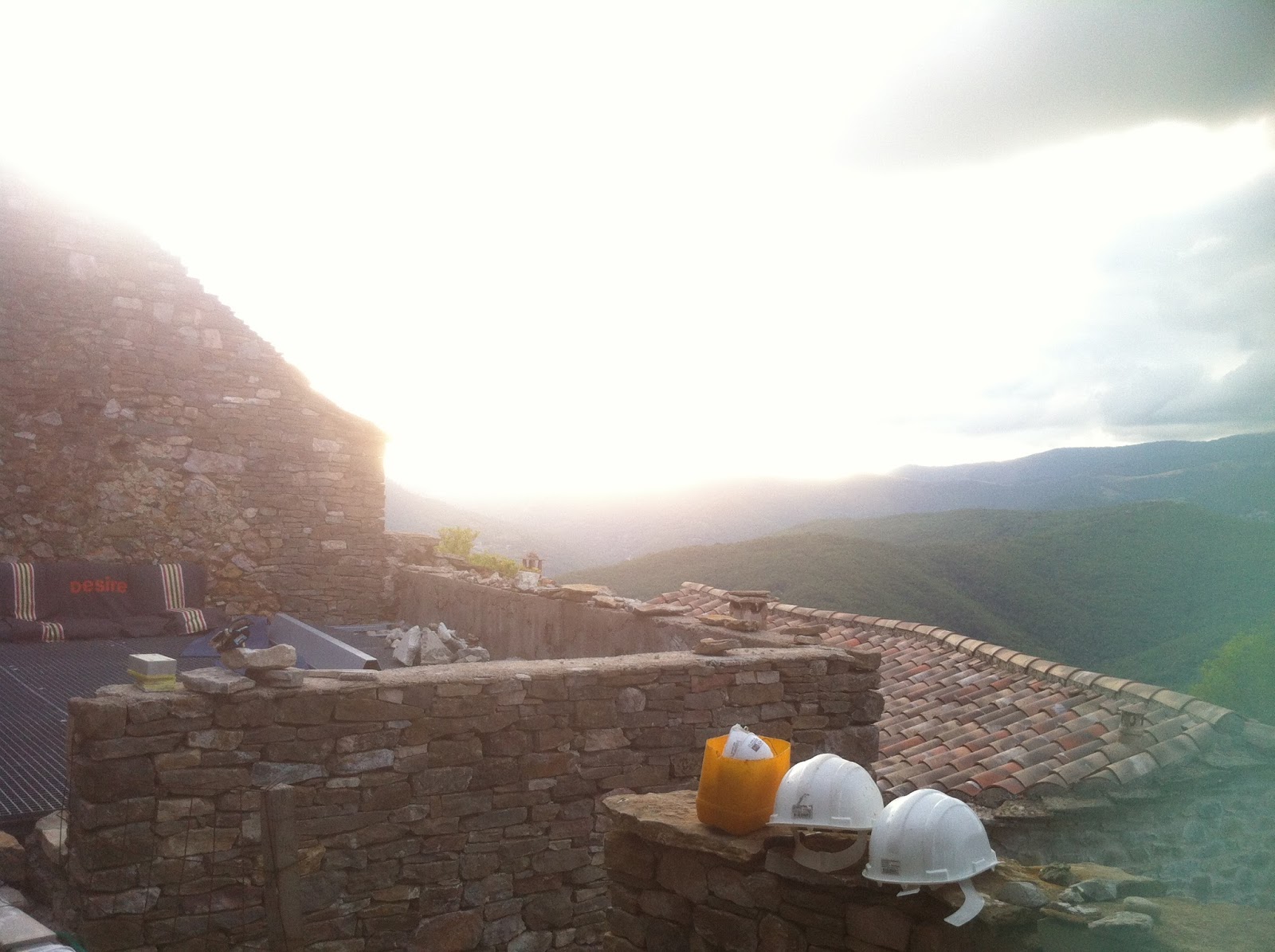
I just got back from helping architect friends to build their house in South of France. One hour from Nîmes, the town with the beautiful light there is a small village on top of a mountain. They bought an old ruin, and preserving the old walls and the layout, they are now building on to it.

There was a full moon, and you could see the moonlit valley and the unfinished roof.
So quiet, you could hear the owl sounds and see the mountains 280 degrees around you.
Everything about this place is just magical.

lördag 30 maj 2015

söndag 19 april 2015

Accidentely on purpose / comme par hasard by Kate McBride

Not long ago one of our friends had an exhibition at La Chambre Claire in Paris, her name is Kate McBride and she is based in Florence. She has since the early 1980's taken polaroids and written short poetic narratives as a travel journal. The polaroid being an instant medium, it catches exactly that moment and feeling of the place and the landscape.

It became a collection book with over 200 polaroids and eighty-four poems, called 'I journey with you here'. I just love polaroids, and I love the milky dreaminess of this journal, it makes you want to travel, travel, travel...


söndag 8 februari 2015

Petra, Jordan / a rose-red city half as old as time

It seems no work of man’s creative hand,
by labour wrought as wavering fancy planned;
But from the rock as if by magic grown,
eternal, silent, beautiful, alone!


Not virgin-white like that old Doric shrine,
where erst Athena held her rites divine;
Not saintly-grey, like many a minster fane,
that crowns the hill and consecrates the plain;


But rose-red as if the blush of dawn,
that first beheld them were not yet withdrawn;
The hues of youth upon a brow of woe,
which man deemed old two thousand years ago,
match me such marvel save in Eastern clime,
a rose-red city half as old as time.

—John Burgon, 1845


Al Khazneh or The treasury at Petra, 1st century AD
Photo credits: http://www.ereduvoyage.ch
Photo credits: http://www.unp.me

Photo credits: http://www.unp.me

Photo credits: http://www.unp.me

torsdag 27 februari 2014

Finding the poetry

Architecture that is sublime or architecture that is thriving, to me, manages to find the poetry - /of a space /a context /an environment and becomes the most it can be. Capturing the specific characteristics of a site, reinventing and playing with the landscape, how a project is a part of or forms something externally and internaly. Finding the poetry is always a common mentioner.

Alvaro Siza is extremely good at finding the poetry. It seems like a sharp eye (pure talent also of corse) and travels can do that to a person.
Like with his Portuguese World expo pavilion from 98, the horizontal thin sheet that is held up on each side by rhythmic columns that forms spaces between them. The sheet is so thin, almost like a boat sail or a paper sheet laying across, that it is hard to grasp how the construction is even made up. The entity forms a frame through which one can see the blue horizon of the ocean.

Sketch by my friend Camilla Levin during our trip to Portugal in 2012
(Portuguese World expo pavilion '98 by Alvaro Siza)