lördag 20 september 2014

The ocean by Mark Tipple

I have an obsession with the ocean, it draws me and scares me. It puts me in awe and invites.
So amazing and sometimes not at all inviting.
Powerful and forceful, pure energy of mass moving...
All of these photos are taken under water by Mark Tipple. Wow.


torsdag 11 september 2014

Landscapes

What inspires me the most of all to create is landscapes.
It can at occasions be cityscapes or urbanized areas but most of all it is natural landscapes.
My dream is to travel the world and just go from place to place to experience them.
Like Bryce canyon, I would like to go there.

Bryce canyon in Utah, photo credits to http://nirvanaexcursions.com/

torsdag 21 augusti 2014

Sanfångaren / The sand catcher by Eva Johansson

I have since a long time thought about changing landscapes and how architecture could change with the landscape. I have specifically thought about tides and water, how architecture could be integrated into that and life cycles.
Dreaming about such a project, I came to think about a very poetic project, diploma thesis at KTH Architecture school in Stockholm by Eva Johansson in 2013.

The project investigates how a structure and spaces can change with the ever-moving sand dunes of north Jylland in Denmark.

This is how she explains her project:

"I am fascinated by landscape that rapidly changes and is shaped by 
wind and water. The wandering sand dune 'Rabjerg Mile' in northern Denmark 
moves across the North Jylland peninsula 15 feet per year. By introducing a 
built structure, a permanent element on site asserts the sand dune's 
rampage and thus man's view of time and place. It is a lookout tower, 
a landmark, a measuring stick, and a visitor centre. The building's main task will be to 
accentuate Rabjerg Miles movement. The sand is active and continuously generates 
new spaces and spatial experiences. 

Rabjerg Mile is one of the largest migratory dunes in Europe. The sand cushion measures 
1 km wide and is moving over the cape in a north-easterly direction. Rabjerg Mile consists of 
about 4 million cubic meters of sand. On average Rabjerg Mile moves about 10-20 
meters per year, depending on the wind strength. 

During the 1500s and 1600s large areas of Denmark  had trouble with
shifting sand. The sand destroyed crops, graveled back roads and forced 
residents to move from their homes. Year 1905 the state bought the land around Rabjerg 
Mile and created a conservation area to preserve the phenomenon moving sand. 
Since then, the sand dune has moved 1.5 km. In about a 100 years the road  
and the railway up to Skagen will be completely sanded over.'


fredag 23 maj 2014

The sky, my roof

Nebula of glowing hydrogen, photo from the Hubble, http://hubblesite.org/

The city

When I was a kid, there was this intro to a television show with a miniature village that captured me every time. The intro was a model of a city on a hill, lit up in the night and it had a train running around it (I believe that the show was called 'skymningssagor').

I think that this one, and other shows with model cities like ('Skrotnisse') completely captivated a child's imagination and I think that looking back, it was one of the things that made me start thinking about architecture and becoming an architect.

There was definitely something about the atmosphere, about seeing the city from afar.
The same fascination led me to night-walks and evening drawings of the city once I moved to Paris.

The city is like this living organism, and during the day you can't see into peoples homes that much even though you are surrounded by other people (around you, moving above you and under you).
But in the night the city lights up and the windows create a mosaic of peoples' lives, many small ones, like looking into a doll house. Everything becomes accessible and the contrasts particularly strong.

I love the way the city transforms in the evenings and the ambiance that being surrounded by hundreds of peepholes of warm lit-up homes creates.
The dynamics of the city captivates me very much.

Night by the Seine, photo by Emelie Nielson 2010

torsdag 1 maj 2014

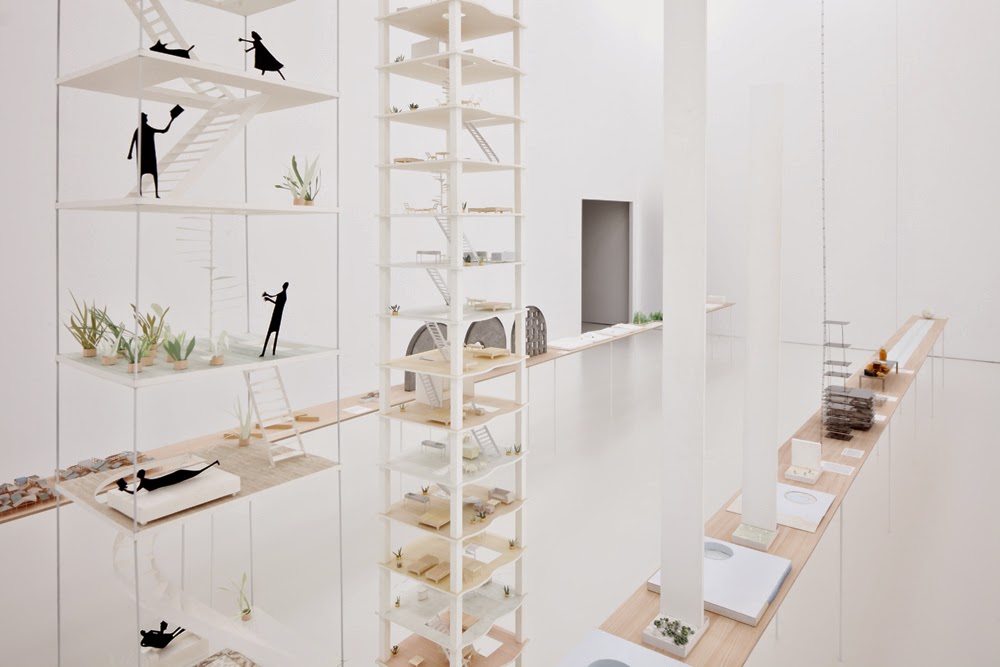
Junya Ishigami, ‘How small? How vast? How architecture grows’

So subtle, all the way from the fine-lined drawing, to the model, to the built.
I could look at the universe of these delicate models all day long.

From the exhibition ‘How small? How vast? How architecture grows’ by Junya Ishigami


Little gardens by Junya Ishigami

Kait Worshop by Junya Ishigami

måndag 14 april 2014

Luis Barragán

Light. Colorful. Multi-facetted.

 
Indoor pool, The Gilardi House, Mexico City, 1975-77


Cuadra San Cristobál, Los Clubes, 1966-68
© Armando Salas Portugal/Barragán Foundation, Switzerland

Casa Gilardi, Mexico City, Mexico 1976


Barragán House, Mexico City, Mexico, 1948
Photo © Barragan Foundation, Birsfelden, Switzerland/ProLitteris, Zurich, Switzerland