

fredag 3 juni 2016

söndag 15 maj 2016
In praise of shadows
 |
| Mouthon Charles-Francois - Academie Beaux arts 1892 |
in praise of old Japanese culture, architecture and practice.
The beauty of this little novel really is food for the soul,
He moves from moonlit toilets at the Kyoto temple to dark lacquerware glimmering like jewels in the dark to women with blackened teeth in the pleasure houses, where only their very white skin, sheer as a ghost's transcends out of the darkness.
The Japanese really understand the beauty of time, of ageing and of the sublime in the shadows.
This is Tanizaki's thoughts on toilets:
"Every time I am shown to an old, dimly lit, and, I would add, impeccably clean toilet in a Nara or Kyoto temple, I am impressed with the singular virtues of Japanese architecture. The parlor may have its carms, but the Japanese toilet truly is a place of spiritual repose. It always stands apart from the main building, at the end of a corridor, in a grove fragrant with leaves and moss. No words can describe that sensation as one sits in the dim light, basking in the faint glow reflected from the shoji, lost in meditation or gazing out at the garden. The novelist Natsume Sōseki counted his morning trips to the toilet a great pleasure, 'a physiological delight' he called it. And surely there could be no better place to savor this pleasure than a Japanese toilet where, surrounded by tranquil walls and finely grained wood, one looks out upon blue skies and green leaves.
As I have said there are certain prerequisites: a degree of dimness, absolute cleanliness, and quiet so complete one can hear the hum of a mosquito. I love to listen from such a toilet to the sound of softly falling rain, especially if it is a toilet of the Kantō region, with its long, narrow windows at floor level; there one can listen with such a sense of intimacy to the raindrops falling from the eaves and the trees, seeping into the earth as they wash over the base of a stone lantern and freshen the moss about the stepping stones. And the toilet is the perfect place to listen to the chirping of insects or the song of the birds, to view the moon, or to enjoy one of those pognant moments that mark the change of the seasons. Here, I suspect, is where haiku poets over the ages have come by a great many of their ideas. Indeed one could with some justice claim that of all the elements of Japanese architecture, the toilet is the most aestetic. Our forbears, making poetry of everything in their lives, transformed what by rights should be the most unsanitary room in the house into a place of unsurpassed elegance, replete with fond associations with the beauty of nature..."
onsdag 11 maj 2016
My kitchen table this evening
 | |
|
söndag 28 februari 2016
There is not enough fantastical architecture out there
Claude Parent passed away yesterday at the age of 93, the world lost a great architect.
We just went to see an exhibition at Galerie Azzedine Alaïa in Paris with three museum projects of his presented the other week.
I am so impressed by the world of Claude Parent, he worked right up until his death, only the the hand-drawn lines were shakier.
There is not enough fantastical architecture out there, I wish that many more of his project were built!
His work is really one of a kind, between utopia and reality, the French pavillon for the Venice Biennale in 1970 for example reminds me, in some ways of one of my favorites, 'Lustiga huset' at the amusement park Gröna Lund in Stockholm. A house which proportions and features takes you through a mind-game where the stairs move, you walk on something that you don't know if it is a wall or a floor. This house will always stay in my memory since childhood in the same way Claude Parent's work always makes you want to explore the world of his oblique architecture.
Vive l'architecture oblique! His work will live on forever.
 |
| Project presented by Claude Parent at the 1970 architecture biennale |
 |
Project presented by Claude Parent at the 1970 architecture biennale |
 |
Project by Claude Parent at the 1970 architecture biennale |
 |
Drawing by Claude Parent |
tisdag 26 januari 2016
Continuous space
One of the things that make me dream the most...is continuous spaces, linear continuous spaces.
Here are three uninterrupted spaces: two by the SANAA ensemble and one by Ryue Nishizawa on his own.
They are quite similar, responding to the different programs with the same elaboration, the new generation of Japanese continuity.
 | |
|
 |
| Teshima art museum by Ryue Nishizawa and artist Rei Naito, photo credits: Illabo |
 |
| Rolex learning center by SANAA, photo credits: © SANAA by Cyrille Thomas |
 | |
|
söndag 29 november 2015
Noémie Goudal 'Observatoires' 2015
I can't get these mesmerizing images by french artist Noémie Goudal out of my head.
Surreal, barren landscapes where abandoned architecture meets nature in a dreamy, theatrical setting...
(Inspired by Jantar Mantar, built in Jaipur, India, in the 18th Century)


fredag 4 september 2015
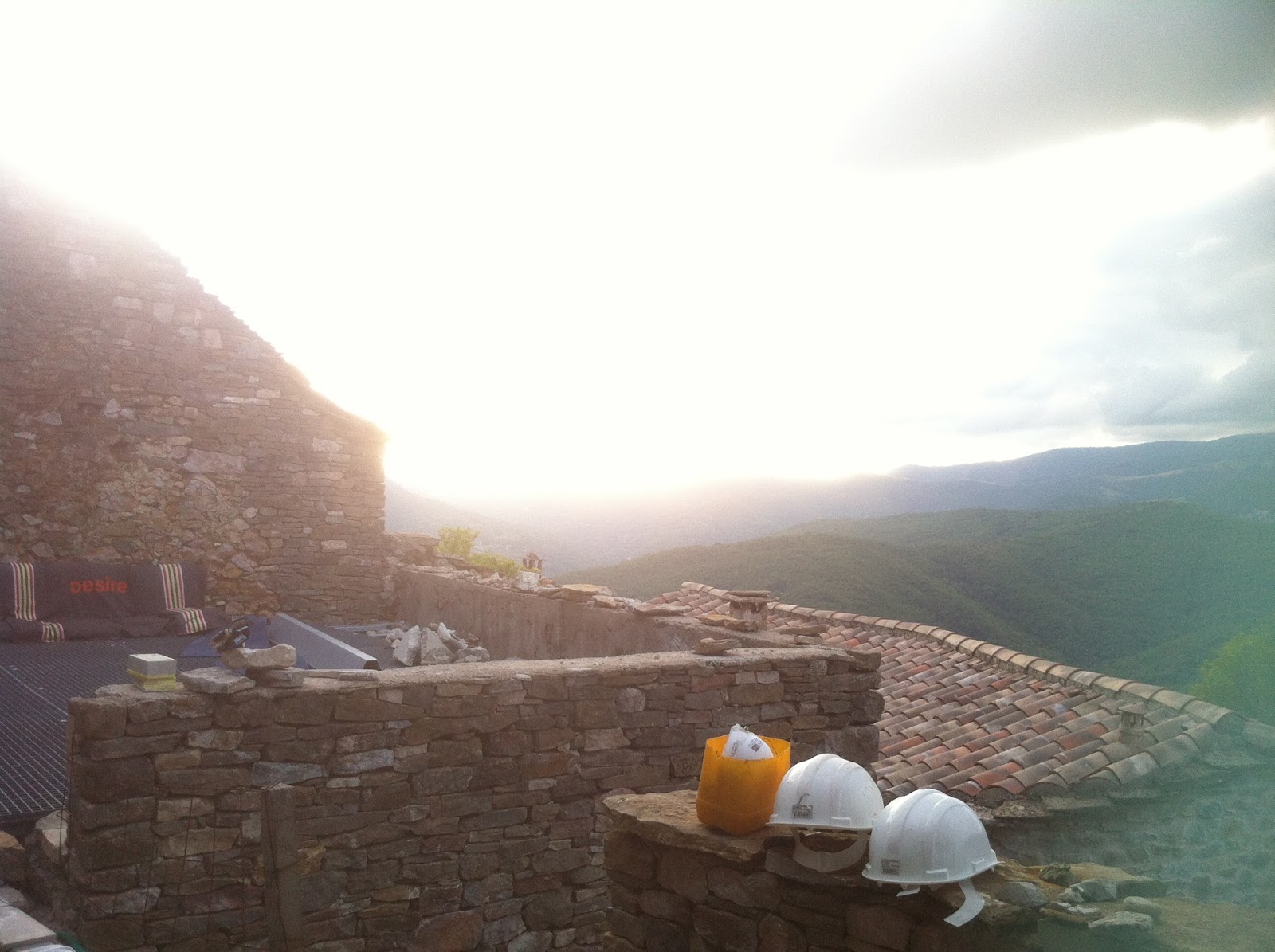
Esparon, the house on a mountain
I just got back from helping architect friends to build their house in South of France.
One hour from Nîmes, the town with the beautiful light there is a small village on top of a mountain. They bought an old ruin, and preserving the old walls and the layout, they are now building on to it.
There was a full moon, and you could see the moonlit valley and the unfinished roof.
So quiet, you could hear the owl sounds and see the mountains 280 degrees around you.
Everything about this place is just magical.


There was a full moon, and you could see the moonlit valley and the unfinished roof.
So quiet, you could hear the owl sounds and see the mountains 280 degrees around you.
Everything about this place is just magical.



Prenumerera på:
Inlägg (Atom)