torsdag 1 maj 2014

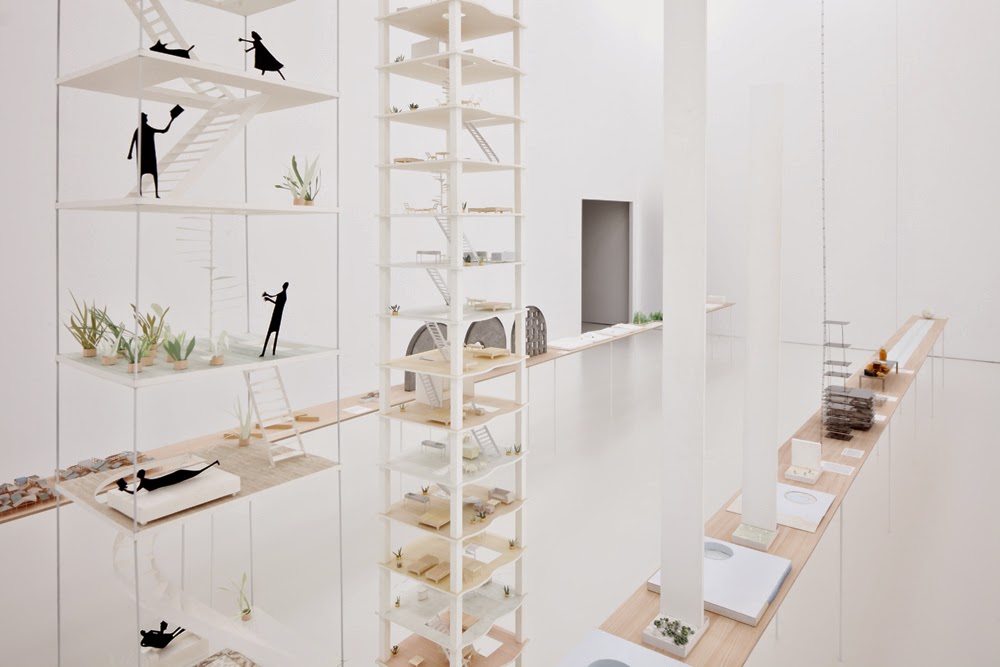
Junya Ishigami, ‘How small? How vast? How architecture grows’

So subtle, all the way from the fine-lined drawing, to the model, to the built.
I could look at the universe of these delicate models all day long.

From the exhibition ‘How small? How vast? How architecture grows’ by Junya Ishigami


Little gardens by Junya Ishigami

Kait Worshop by Junya Ishigami

måndag 14 april 2014

Luis Barragán

Light. Colorful. Multi-facetted.

 
Indoor pool, The Gilardi House, Mexico City, 1975-77


Cuadra San Cristobál, Los Clubes, 1966-68
© Armando Salas Portugal/Barragán Foundation, Switzerland

Casa Gilardi, Mexico City, Mexico 1976


Barragán House, Mexico City, Mexico, 1948
Photo © Barragan Foundation, Birsfelden, Switzerland/ProLitteris, Zurich, Switzerland


måndag 7 april 2014

Lightness

Weightless, almost transparent architecture fascinates me. There are a few japanese architects who work with just that, dissolving the limits of the built, that creates an almost dreamlike atmosphere.

The absolute weightless architecture, something that could be identified as lightness or dissolving or transparent, is like this architecture dream, that is realised and keeps the dreaminess and doesn't lose on the way to construction.

Sublime and dreaming go very well together and lightness definitely makes me dream.

Japanese pavilion at the 2008 Venice architecture biennale, by Junya Ishigami

Serpentine pavilion 2009 in Hyde Park, London by SANAA


House NA, also called Transparent House, 2010, by Sou Fujimoto Architects

måndag 31 mars 2014

SALT

The dead sea, Israel, photographer unknown

The dead sea, Israel, photographer unknown

Salinas grandes, Jujuy, Argentina, photographer unknown

Salinas grandes, Jujuy, Argentina, photographer unknown


Salinas grandes, Jujuy, Argentina, photographer unknown

Saltworks in Bilma, Niger, photographer unknown

Saltworks in Bilma, Niger, photographer unknown

Saltworks in Bilma, Niger, photographer unknown

måndag 24 mars 2014

Memory/Ruins

I have been flickering through photos of abandoned buildings/homes for a while, photographers like Bryan Schutmaat or Marchand and Meffre's photos of Detroit. There is something fascinating about ghost towns, about looking into peoples homes, and something even more fascinating looking at ruins, something touched, and then untouched.
What remains? What takes over the space?
It lives on, lives its own life, when everyone else has forgotten about it.

I think that just the presence of the abandoned creates very special state of mind. An atmosphere of void or chaos or just stillness.

A place always has memory. Sometimes its easy to read (or not) but the case of finding the poetry is also the case of finding the memory. To be able to read it (the memory, mystery and actions at a place) and to reread it or reinforce it, to create a new memory.

Memory can also be about associations, how we relate to our world. So different people would have diferent associations. Although architects often talk about "the soul" of a place, which then would be somehow at least semi-separated from our own associations.

Places definitely have an identity of its own, in my opinion (or lack of identity) independent of peoples associations. The sublime has memory.

From 'Grays the Mountain Sends' by Bryan Schutmaat

Ghost town Keelung, Taiwan by unknown photographer

torsdag 27 februari 2014

Finding the poetry

Architecture that is sublime or architecture that is thriving, to me, manages to find the poetry - /of a space /a context /an environment and becomes the most it can be. Capturing the specific characteristics of a site, reinventing and playing with the landscape, how a project is a part of or forms something externally and internaly. Finding the poetry is always a common mentioner.

Alvaro Siza is extremely good at finding the poetry. It seems like a sharp eye (pure talent also of corse) and travels can do that to a person.
Like with his Portuguese World expo pavilion from 98, the horizontal thin sheet that is held up on each side by rhythmic columns that forms spaces between them. The sheet is so thin, almost like a boat sail or a paper sheet laying across, that it is hard to grasp how the construction is even made up. The entity forms a frame through which one can see the blue horizon of the ocean.

Sketch by my friend Camilla Levin during our trip to Portugal in 2012
(Portuguese World expo pavilion '98 by Alvaro Siza)


fredag 7 februari 2014

Sublime blog

I am freaking out over this amazing blog: http://tectonicablog.com that has everything innit!


Landesarchiv NRW by O&O Baukunst Architects